
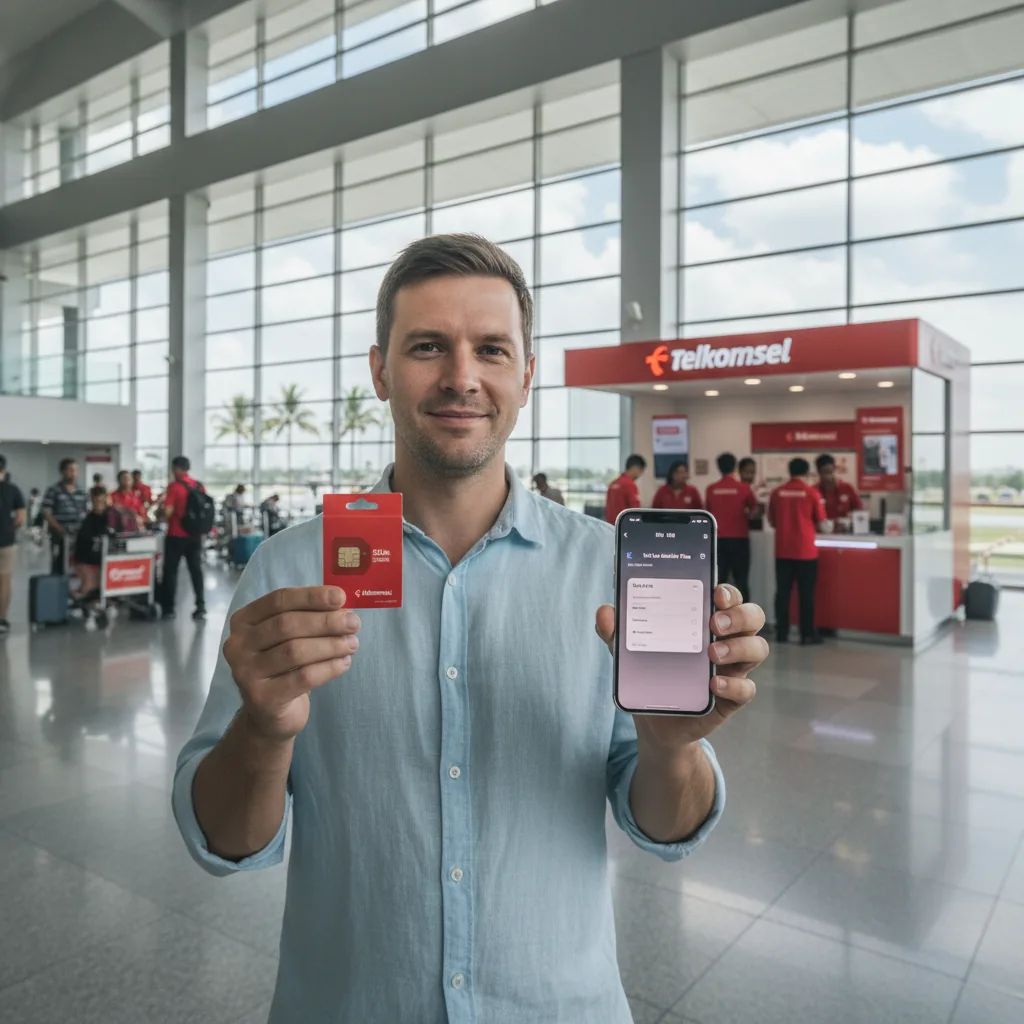
Short answer: Skip the airport SIM kiosks if you can. They charge roughly two to three times city retail for the same Telkomsel packages, and queues at peak arrivals run longer than immigration. A pre-ordered eSIM activated on landing is cheaper and faster for most phones; otherwise buy at an official Telkomsel store in town the next day.
Walk out of Bali immigration and within ninety seconds someone will offer you a SIM card. Within five minutes you’ll have been quoted three different prices for what looks like the same thing. Here’s the no-nonsense rundown: which airport SIM options are worth it, which to skip, and what we’d actually recommend doing.
Key Takeaways
- Bali airport SIM kiosks typically charge two to three times the city retail price for the same packages.
- Telkomsel has the best Bali coverage; XL is second; Indosat third.
- Pre-ordered eSIMs activated before you land are the cheapest and fastest option for compatible phones.
- SIM kiosk queues at peak arrivals (7–11 PM) run 20–40 minutes — sometimes longer than immigration.
- Most major hotels and villas have decent WiFi; bridge-the-gap data needs are smaller than travellers think.
- Airport kiosks sometimes register the SIM under the wrong passport details, which becomes a headache later.
The kiosk markup is real
Compare any tourist data pack advertised at the DPS arrival kiosks against the same package at an official Telkomsel GraPARI store in Kuta — a roughly 12-minute drive away — and you’ll find the city price is typically less than half. Same SIM, same data allowance, same 30 days. The airport markup buys you queue time and a slightly faster handoff, nothing more.
Here’s why the markup exists: airport retail rents are extreme, you’re a captive audience, and most travellers are too tired to comparison-shop. The kiosks know this. Some of the salespeople work on commission and will steer you to the highest-margin pack regardless of your actual data needs.
Coverage: which network actually works in Bali
This isn’t a marketing claim — it’s what our chauffeurs see day-to-day driving guests around the island.
| Network | Bali Coverage | Speed (4G/5G) | Best For | Worst For |
|---|---|---|---|---|
| Telkomsel | Excellent across the island | 5G in Denpasar/Kuta/Seminyak; 4G everywhere else | Travelling beyond tourist zones, remote villas, North Bali | Nothing major |
| XL Axiata | Good in tourist zones, patchy in interior | Strong 4G in main areas | Budget travellers staying south Bali | Munduk, Kintamani, North Bali |
| Indosat (IM3) | Reasonable south, weak elsewhere | Variable 4G | Cheap data packages | Anywhere outside Denpasar/Badung regency |
| Smartfren | Limited Bali coverage | 4G LTE only | Avoid for travel use | Most of Bali |
If you’re going anywhere beyond Seminyak — Ubud, Sidemen, Munduk, Amed, Lovina, Nusa Penida — Telkomsel is the only sensible choice. We’ve had guests on XL lose signal entirely on the road to Nusa Penida.
Option 1: Pre-ordered eSIM (best for most travellers)
If your phone supports eSIM (iPhone XS or newer, most flagship Android from 2020+), this is the easiest path. You order online, scan a QR code, and the eSIM activates the moment your plane touches down — no queue, no kiosk, no passport-photo registration drama.
Tourist eSIM packages running on Telkomsel infrastructure generally cost around half of what an airport kiosk charges for the equivalent physical SIM, and the bigger the bundle the better the per-GB rate. If you’d rather not research providers, mention it when you book an arrival concierge service and our airport desk will point you to a reputable option before you fly.
Option 2: Physical SIM at a Telkomsel city store
If you don’t have an eSIM-capable phone, the next-best move is to use your hotel WiFi for the first night, then visit an official Telkomsel GraPARI store the next day. Three Bali GraPARI locations are open daily:
- GraPARI Renon (Denpasar) — full service, English-speaking staff
- GraPARI Kuta — closest to most south Bali hotels
- GraPARI Ubud — convenient if you’re heading north on day one
You’ll pay far less than at the airport, get a properly registered SIM, and have someone who actually understands data plans. Bring your passport.
Option 3: Airport kiosk (last resort)
If you genuinely need data the moment you land — say you’re coordinating a complex pickup or a same-day domestic connection — the airport kiosks work. They’re just expensive and slow. To minimise the pain:
- Decide on package size before approaching the kiosk. Don’t let them upsell.
- Confirm passport registration is correctly typed before paying.
- Pay in IDR, not USD. The exchange rate at airport kiosks is brutal.
- Test the SIM works before walking away — including data, not just signal.
Option 4: Skip the SIM entirely
Counterintuitive, but: most travellers buy more data than they need. If you’re staying at a decent hotel or villa, in-room WiFi handles 80% of usage. Short-trip travellers (3–5 days) often do fine with hotel WiFi plus a small eSIM bundle. And if your driver is pre-booked with a private airport pickup, the one moment you’d really want data — finding your ride — is already handled by a nameboard at the arrivals rail.
Where you genuinely need cellular data:
- Grab/Gojek bookings (taxis, food delivery)
- Google Maps while in transit
- WhatsApp with your driver or villa host
- Translation app at a local warung
For most of these, 5–10GB across a week is plenty.
The “wrong passport registration” trap
Indonesia requires SIM cards to be registered to a passport. Airport kiosks rush this step. We’ve seen SIMs registered to a misspelled name (Smith → Smit), the wrong passport number, or — worst case — to the kiosk staff member’s ID instead of the buyer’s. The SIM works initially. Then in 7–14 days the network deactivates it for failed verification, mid-trip.
If you do use an airport kiosk, watch them type. Confirm passport number digit-by-digit. Get the receipt with your name on it. It sounds paranoid until it happens.
Bali airport WiFi — useable or not?
DPS has free WiFi in the international terminal. It’s fine for messaging and email. It’s not enough for video calls or heavy streaming. The signal is strongest in the immigration hall and at gates; it weakens in the food court area.
If you have lounge access — Premier Lounge, Concordia, Saphire, or via Priority Pass — the lounge WiFi is significantly better. Full breakdown of access options in our lounge access guide.
Quick decision tree
- iPhone or newer Android, planning ahead → Pre-order an eSIM. Done.
- Older phone, can wait one day → Hotel WiFi night one, GraPARI store day two.
- Need data immediately → Airport Telkomsel kiosk; expect to overpay, and watch the registration.
- Short trip, mostly at hotel → Skip SIM entirely; rely on hotel WiFi + eSIM data backup.
- Travelling beyond south Bali → Telkomsel only, no exceptions.
One more thing — international roaming
If your home plan offers free or cheap roaming in Indonesia (some Australian, Singaporean, and EU plans do), that’s often the best of all worlds — no setup, your normal number works, and you can buy a local eSIM later for cheaper rates if needed. Check your carrier’s Indonesia roaming policy before assuming you need a SIM at all.
For guests arriving on our VIP assistance service, connectivity is one of the things worth mentioning at booking — the airport desk can arrange a data option ahead of arrival so you walk out already online, with no kiosk queue in between.
Frequently Asked Questions
Is it cheaper to buy a SIM at Bali airport or in the city?
City stores are far cheaper for the exact same Telkomsel package — often less than half the airport price. The kiosk markup exists because of captive demand, not better service. If you can wait one day, GraPARI city stores are the right move.
Which network has the best Bali coverage?
Telkomsel, by a clear margin — especially outside south Bali. XL is decent in tourist zones; Indosat is patchy beyond Denpasar/Kuta. For Ubud, North Bali, or Nusa Penida, only Telkomsel reliably works.
Can I use eSIM in Bali?
Yes. Pre-ordered eSIMs are widely available and run on Telkomsel infrastructure. They activate the moment your phone connects to the local network, with no queue and no kiosk. Best option for compatible phones (iPhone XS+, most 2020+ Android flagships).
Is Bali airport WiFi any good?
Free DPS WiFi works for messaging and basic email but isn’t reliable for video calls or streaming. Lounge WiFi (Premier, Concordia, Priority Pass lounges) is much better.
How much data do I actually need for a Bali trip?
For 7–10 days with hotel WiFi as primary, 5–10GB on cellular is plenty. Most travellers oversize. Heavy users (no hotel WiFi, lots of streaming, video calls) might need 20–30GB.
What happens if my airport SIM stops working mid-trip?
Usually a passport registration error from the rushed airport kiosk. Take the SIM and your passport to any official GraPARI store; they can reregister or replace it. Allow an hour.
Want connectivity sorted before you land? Ask when you book your transfer — our 24/7 airport desk, operated by Bali Premium Trip, can arrange a pre-activated eSIM option so you walk off the plane already online. WhatsApp +62 811 2859 0000 with your phone model and we’ll handle the rest.
Related reading
Related reading
- Best eSIM for Bali in 2026 — instant data the moment you land